First Timer’s Guide to Agile Mobile Development: Exploring the different phases of mobile app development
Learn moreSwipe to Check More

If youve ever seen the software project fail because an "small" change in a requirement occurred during the fourth month youll know why the spiral model is in existence. The majority of SDLC models require you to secure requirements before you start and then hope that nothing changes. The spiral model is the opposite and assumes that everything are likely to change and incorporates risk analysis into each cycle of development.
This guide will explain what the spiral model is and how its four phases function in practice, the areas where it is superior to Agile and Waterfall and in the areas it isnt, and what it really costs to run a spiral-based project in 2026.
The spiral model is a software development method that combines the planned design of the Waterfall model with the flexibility of iterative development.
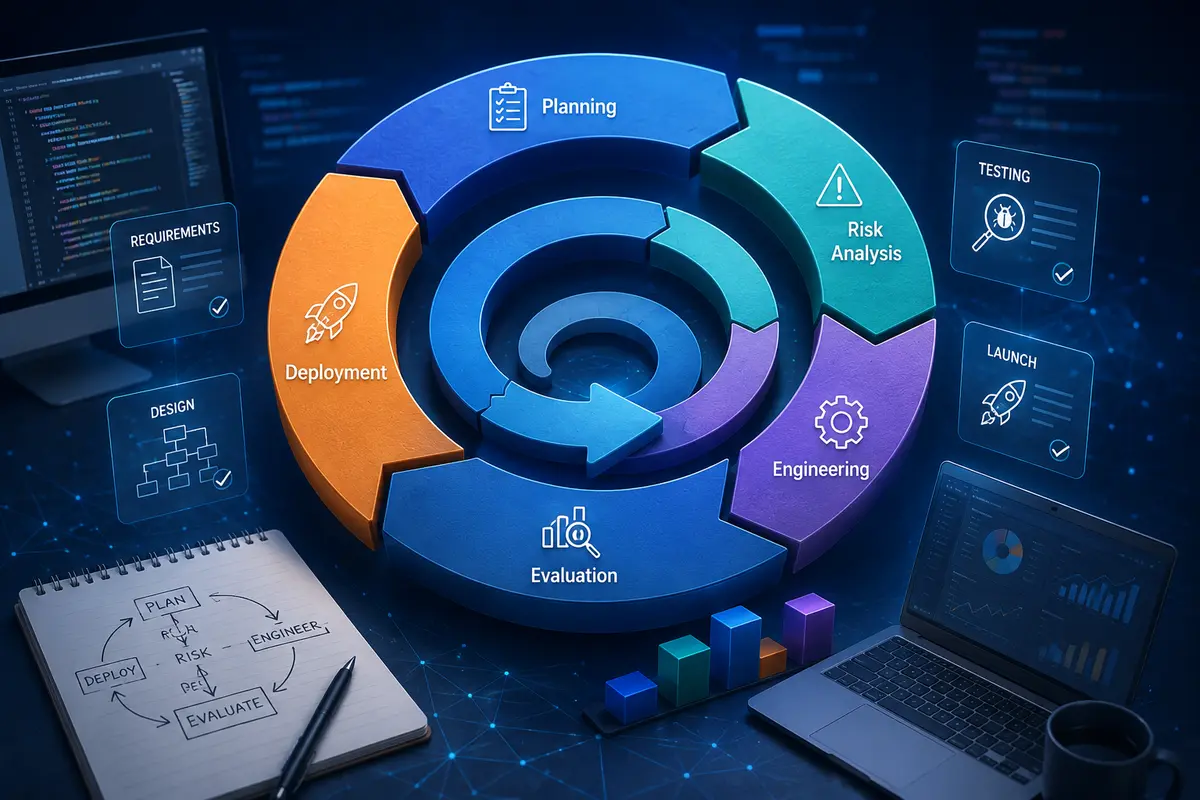
Instead of moving through development in a straight line, the program follows the same process that is that is a "spiral" consisting of risk analysis, planning engineering, and evaluation every loop producing an improved version of the product.
The idea was first put forward by Barry Boehm in the year 1986. Boehms main idea was that the majority of software projects dont fail simply because of bad code - they fail because the risks (technical or financial related to requirements) arent spotted at an early enough time. The spiral model was created specifically to expose these risks before they become expensive issues.
Contrary to Waterfall which moves forward only after youve completed an entire phase The spiral model views each phase as something youll revisit carefully in the course of the project as it develops. This is what makes it perfect for complex, large, or high-risk projects instead of simple and well-defined ones.
Each loop of the spiral also known as “a cycle" goes through four different phases. Initial loops may create a prototype or requirements document. Later loops create production-ready software.
The team identifies the goals for this particular cycle, assembles the Business Requirement Specifications (BRS) and System Requirement Specifications (SRS) and then identifies constraints like budget timeline, budget, and technology stack. This isnt a simple meeting, but usually results in a specific list of deliverables that include an objective document that is scoped and a list of possible technical solutions and a rough plan of resources for the next cycle.
What makes this different from Waterfalls requirement-gathering stage is that it happens again at the start of every single loop, not just once at the projects beginning. This means that the team wont be trying to anticipate every requirement for the next two years and they just have to plan enough in advance to be able to finish the current cycle without incident.
Example: For a healthcare records platform, the initial spiral could focus on the definition of what "patient access to data" must be for a specific user role -- for instance front desk staff - without writing any code. A subsequent spiral could revisit the same issue for specialists and doctors after the first version has been tested and verified.
This is what distinguishes the spiral model from other SDLC approach. The team determines the financial, technical operational, and other risk for this cycle, then evaluates alternative methods, and determines the best way to minimize the most serious threats prior to the beginning of development.
In reality, this process typically involves evaluating risks based on both impact and likelihood and deciding which are serious enough to warrant an initial proof-of-concept or a spike before the actual engineering work gets underway. Common risk categories that teams consider in this regard are technical feasibility (can this architecture really grow? ) Third-party dependability risk (will this vendors API be able to withstand the strain? ) and the risk of regulatory compliance (does this method meet regulations for compliance? ) as well as the risk of budgeting (is the estimate cost reasonable considering the level of complexity).
The reason this stage is not negotiable in the spiral model -- as well as frequently delayed or skipped in other approaches is because unresolved risk doesnt disappear if you dont address it. It comes back later, typically in the course of testing or post-launch which is a lot more costly to correct.
Example: If the biggest danger is if the third-party payment gateway is able to handle the expected volume of transactions this stage could include constructing a small proof-of-concept to test that assumption prior to investing engineering resources into complete checkout development. If the proof-of-concept doesnt work the team switches to a different provider within the same time frame instead of identifying the issue over the course of several months of research.
The actual construction occurs -- UX/UI design programming, testing, and coding. Based on the specific project, teams might follow a Waterfall-like sequence within the loop or take a more Agile and incremental approach. Since the risks of assumptions were confirmed in the second phase the phase is likely to move more quickly and with less surprises than in a model that does not include the risk analysis part.
Testing here isnt just about the detection of bugs. Its as well where the team is able to determine whether the product actually is in line with the goals that were set in Phase 1. Anything that isnt up to par gets identified for evaluation rather than being silently released.
Example: Once the payment gateway risk is eliminated the team creates and runs tests on the actual checkout process for that cycles duration, including the possibility of unforeseen cases such as unsuccessful transactions, retries as well as refund processing, as they are precisely the type of things that are overlooked when a project does not undergo an official risk analysis step.
Users and stakeholders look over the models design, offer feedback and the team decides what the next phase should be focused on. This is the process that keeps the model evolving instead of a series of disconnected sprints. Each loop directly influences the next.
It is also the place where the scope for the following cycle is established. In the event that the current loop uncovered the existence of a new danger (say that users get confused by a specific flow or a bottleneck in performance came up in the real world of usage) it is the point of departure for the following cycles Phase1 and 2 instead of the unexpected event that was discovered following launch. Over multiple loops, this evaluation-to-planning handoff is what gradually turns a rough prototype into a production-ready system.
| Factor | Spiral Model | Waterfall | Agile | Iterative Model |
|---|---|---|---|---|
| Risk management | Built into every cycle | Minimal, done upfront only | Handled informally, sprint by sprint | Limited, not systematic |
| Requirement flexibility | High — can change each loop | Very low — locked early | Very high — changes every sprint | Moderate |
| Best for | Large, high-risk, complex projects | Small, well-defined projects | Fast-moving products, startups | Medium-complexity projects |
| Documentation | Heavy | Very heavy | Light | Moderate |
| Client involvement | High, at every evaluation phase | Low, mostly at start/end | Continuous | Periodic |
| Cost predictability | Low — hard to estimate upfront | High | Moderate | Moderate |
| Time to first working version | Slower than Agile | Slowest | Fastest | Moderate |
The short version: Agile wins on speed, Waterfall wins on predictability, and the spiral model wins when the cost of getting something wrong is too high to risk either of those trade-offs.
In fairness to the teams that are evaluating this model not without its flaws:
The spiral model isnt only an idea It has been used to design some of the most intricate software ever created:
The common thread throughout all of them is high stakes, changing expectations, and a price of failure that is too high for the "build it once and then hope" approach.
While the spiral model might be the best option, teams can make the wrong choice in their execution. Some patterns are seen often:
Since the spiral model cant alter the amount of cycles prior to each cycle Cost estimation and timeline estimation is different than with Waterfall.
If a vendor offers you one fixed price and time frame for a truly complex, high-risk project its usually a sign that theyre not planning on running risk analysis properly.
At Corewave we dont try to oblige every client to the same SDLC model. For large, high-risk designs -- enterprise platforms, fintech solutions and systems that have real compliance risk we rely on the risk-first approach that the spiral model was based on: identify what can go wrong before its costly to fix it, test assumptions early using prototypes, and let feedback from real stakeholders guide the next stage of work.
If youre planning to build a complex or high-risk software project Our staff at Custom Software Development Company can assist you in determining if spiral or hybrid approach is the best choice for your project.
Are you in the NCR region? Are you in the NCR region? Software Development Company in Gurgaon team collaborates directly with fintech and enterprise clients who require this type of risk-management development process.
Its principal goal is to reduce risk. Each cycle of the spiral model devotes an entire phase to identifying and reducing risk prior to any further development This is distinct from other SDLC models.
Its not. Both are iterative. However, the spiral model comes with a formal, mandatory risk-analysis phase that is part of every cycle while Agile is more focused on speed and continual delivery. It does not have an official risk assessment process that is built into every sprint.
spiral model was developed by Barry Boehm in the year 1986 as a way of combining the design of Waterfall with the flexibility of iterative development focused on risk management.
Generally speaking, there is no. The expense of conducting formal risk analysis on a regular basis can be costly and slow for smaller, simple or projects with low risk. Startups who are developing MVPs tend to be more efficient with Agile.
Each spiral cycle is comprised of four phases including planning engineering, risk analysis and evaluation. The number of cycles isnt fixed, its contingent on the size of the project and its risk profile.
Yes. Many teams use a hybrid approach, using a spiral-style risk assessment at the beginning of important phases followed by carrying out the actual engineering work in agile sprints. This is typical in enterprise software where both risk management and speed of delivery are crucial.
Theres not a set duration as it is contingent on the projects complexity and the scope thats defined during the planning phase. Some cycles run for a few weeks while others, particularly the risk-heavy early loops in enterprise projects could take several months. What is more important than the exact timeframe is that every cycle has a clear goal before it even begins.
It could however, its generally only useful for big, high-risk mobile apps such as enterprise mobile platforms that have complex integrations and regulatory requirements. For a consumer-oriented application, the expense of conducting a formal risk assessment every cycle isnt always justifiable and an Agile method will bring your app to market quicker.
The spiral approach isnt the best option for every projectand it wasnt intended to be. However, in the case of large, high-risk or complex software development projects the risk-first model can spot costly problems before they turn into costly mistakes. If your project is a real financial, regulatory or technical risk Its worth looking into the possibilities of spiraling or a a hybrid approach can save you from the kind of rework at the end of the process that squanders budgets and timeframes.